|
|
|
|
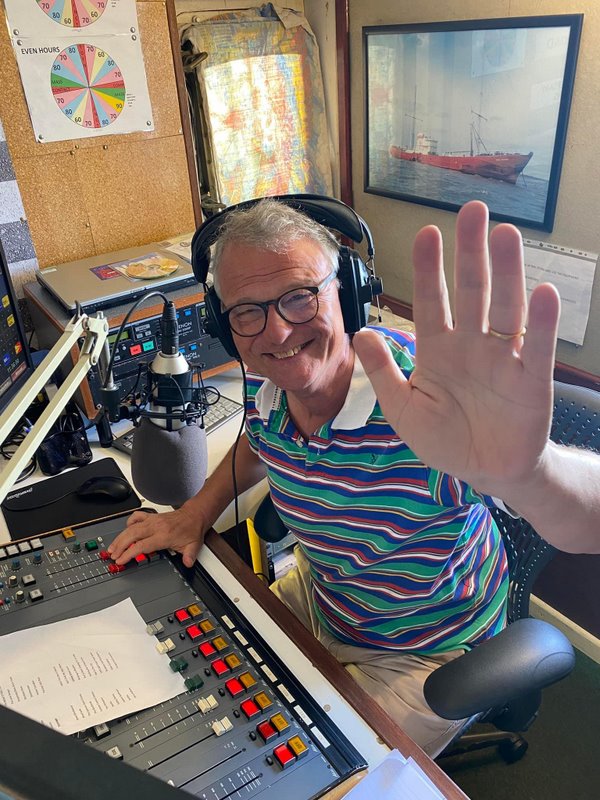
James Ross in the studio on Ross Revenge for the 2022 Spirit of the 70s reunion broadcast.
|
Ray Clark has interviewed numerous people involved with Radio Caroline for documentaries and for his book, Radio Caroline: The True Story Of The Boat That Rocked (reviewed here).
One of his interviews was with disc-jockey James Ross.
James joined Radio Caroline in June 1975 when the station was only providing a night-time service, initially broadcasting as Kelvin Carter until, as he recounts below, an encounter with the police prompted a change of name.
He was then one of the team that brought us the fondly-remembered all-day Caroline service which operated from May 1976 to November 1977. He left the station in March 1978.
Along with some of his colleagues from the seventies, James made a welcome return to Caroline for a reunion broadcast in July 2022 (photos here).
We are grateful to Ray for sharing this recording with us.
RAY CLARK: How did you get involved with Caroline?
JAMES ROSS: The tricky ones first I see! I used to listen to Caroline and Radio London. I remember going with my uncle in September 1967 to a garage showroom. He was buying a new car and I was going “why aren't you listening
to Caroline?” “Oh, it's stopped.” I said, “No, it's not, it's carrying on.” All the others had closed down, but this one hadn't. And I thought, how exciting. Anyway, after a great deal of persuasion,
they found it on the car showroom radio and we put it on that. That was my first little sprinkling of thinking, this is quite exciting. Then we fast forward three years to 1970 and I was at Scout Camp and the music we were
listening to came from RNI and there were a couple of really naff tracks and everybody was going “oh, it sounds better with the jamming”! And again, I thought, this is quite good. Then there was the big march and
“Who do you think you're kidding, Mr Wilson?” and, again, I thought that was exciting. Then there was the closedown of RNI, 1970, September and then it returned. Then there were reports that Caroline was going to open an
offshore museum in the early 70s and of course, that didn't happen, but Caroline returned and I enjoyed listening to Caroline, Seagull. I still enjoyed RNI, but RNI was just a little bit too much like Radio One. I enjoyed it, but the
Caroline thing had a slight anarchic feel to it and I liked the DJs, they talked to me. And then it came back to the UK after the Dutch Marine Offences Act. I think that was '74 and I was able to listen to it then, because reception
was better. I got involved with a couple of local land-based pirates and I found out who was organising Caroline. They were in South Kensington. I've actually forgotten his name[1]. He was an American and I
asked if I could join and rather naively, I just put some records together and spoke between the records, but with one record player and one tape recorder and one microphone. Obviously, as I think everybody was, I was rejected
for no apparent reason and then, all of a sudden, got a phone call saying, “would you like to take part?” (Station boss) Ronan (O'Rahilly) was involved in lots of wheeler-dealing and record labels. We were asked to go up
to the Midlands where he had heard that the market research company that was in charge of doing the charts was going round and collating the number of sales at record shops. We went up there and went to one record shop, bought the
record, went to another record shop, bought the record, went to another record shop, bought the record, had lunch and then did the same three record shops again, hoping that there'd be different people on the till. The next
thing was in June, June the 14th, 1975, I went out and did my first programme. It was 12 until 2am because we used to close at 2 and the reason we used to close is because Radio Mi Amigo was on tape and we (the Caroline DJs) had to
play in the tapes. Each tape lasted an hour and, again, a special Ronan deal was that they could keep all the money from the hour-long tapes and Caroline, brackets Ronan, would keep the money from the top of the hour, the very memorable
K-Tel adverts and the other ones. We used to play those in and then we put together a programme - and drank too much whiskey and coke. At the time, because of Mi Amigo making so much money, conditions on the ship were absolutely
incredible. There was a captain, a sailor, an engineer, a transmitter engineer, a cook and sometimes a second deckhand. We would have breakfast, lunch, dinner and an evening night cap, all provided by, well, the chef I remember was
Gunter and it really was top quality stuff with a hint of Dutch and German cuisine. And, you know, if we were finishing at two, three o'clock in the morning, we'd raid the deep freeze and make a steak sandwich. It was lovely.
 A short clip from the start of a Kelvin Carter show in July 1975, taken from a recording shared on the Radiotrefpunt (radio meeting point) forum
by Scotty. Our thanks to him (duration 1 minute 3 seconds)
A short clip from the start of a Kelvin Carter show in July 1975, taken from a recording shared on the Radiotrefpunt (radio meeting point) forum
by Scotty. Our thanks to him (duration 1 minute 3 seconds)
| RADIO CAROLINE PROGRAMME SCHEDULE |
| 14th June - 29th July 1975 |
7.00pm Simon Barrett
10.00 Phil Mitchell
12.00am Kelvin Carter
2.00 closedown
|
RC: Sort of 75-ish?
JR: 75, 76. Yeah, absolutely incredible. The bad news was we were on the boat for two or three months at a time because the Dutch and the tapes came out from Holland and Belgium. We came out from France. We came out separately.
We were a completely separate operation. Radio Mi Amigo organised and paid for the running, the upkeep and all the costs of the Mi Amigo and we enjoyed it.
| RADIO CAROLINE PROGRAMME SCHEDULE |
| 6th - 13th June 1976 |
6.00am James Ross
9.00 Tony Allan
12.00pm Stuart Russell
3.00 Samantha Dubois
6.00 James Ross
9.00 Tony Allan
12.00am Stuart Russell
3.00 Samantha Dubois (-06.00)
|
RC: So when did things start going wrong then, if things were so good in '75, '76?
JR: I was there until I think February, March '76. Then I went to the Voice of Peace for three months. Then I returned to Caroline and I think it was okay then but there were a couple of really dynamic organisers on the Dutch side
who were amazing, but they left. Whether they were arrested or they left or they got another job, I don't know. You hear so many stories, you don't know what the truth is. So then we had a ragtag of organisers. One or two were
brilliant but a lot of people were friends of friends of friends of friends of friends who maybe could organise filling up a car with petrol, but organising a couple of hundred tons of diesel oil to come out and fill the Mi Amigo up,
fill the tanks up, was something else. It then started to go downhill a bit. And this is where my memory becomes just a little vague. We weren't getting water. We were getting supplies from the UK. The water tanks ran out. And there
was a very distinct difference in that 18 months from when I joined and there being showers all the time to having to sometimes shower in seawater. Sometimes the water was so low, we had to bleed the radiators to get non-seawater into
the kettle and to boil that. Food was short but when you were in your early 20s or late teens, as some were, you didn't really think of that. You were having such a good time. I mean, we were doing two shows a day. We were playing
records. We were pretty autonomous - apart from the occasional threats that came back about don't pay anything off the new Abba album! - but it was an absolute joy. But then after a while, conditions got so bad that you just thought,
well, time for a break. Fortunately, I was offered a job on Swansea Sound so I did that.
| RADIO CAROLINE PROGRAMME SCHEDULE |
| 4th - 17th February 1978 |
6.30pm Mark Lawrence (m-th)
James Ross (Listeners Top 30 f-sun)
9.00 James Ross (m-th, mon:“Countdown of Album Sounds”)
Mark Lawrence (Listeners Top 30 f-sun)
12.00am Mike Stevens
3.00 Martin Fisher
6.00 Radio Mi Amigo
|
RC: And that was it?
JR: That was it. Yeah, I think that was February, March 1978.
RC: That's quite a run though, isn't it?
|
|
|
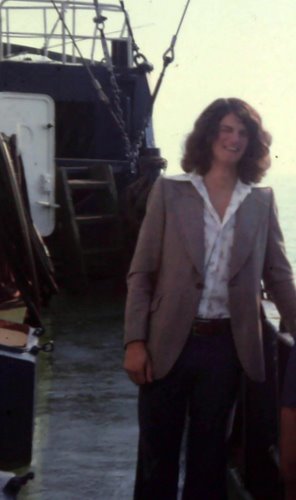
James, looking smart on the deck of mv Mi Amigo. Photo shared by the man himself on Facebook.
|
JR: It was a good run. And I made some really good friends. Obviously, there were a couple of people you didn't get on with. You were allowed to be creative... As you know, following this, I became a producer and
there must have (already) been a hint of production because I was thinking, how can I get through this programme? Somebody wrote to me and requested a few records and I played them and I said, “this is really good, if you'd like
five records played, just send us your top five and I'll do that for you”. Anyway, then some people got completely carried away - in a good way - and they'd send top 20s. And then we decided, hang on a second, we could make this
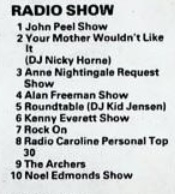
into an entire two hour show so we developed this thing, the Personal Top 30, which rather flatteringly featured in the NME top 10 radio programmes of 1978 or '77. It was alongside John Peel, Kenny Everett and you think, wow, this is
quite fun. And so there was that. Obviously there were a few colleagues who preferred to play their own choice of music, which was fine, but a lot of people played along and it seemed to run and run and run. It was brilliant
because it was a way of getting letters. If you just wanted to say “write in, it'd be great to hear from you” some people would, but some people wouldn't quite know what to say. They needed something to say. So now they
would write their top 10, top 20, top 30, but also they would tell you a bit about themselves, which was wonderful, because I know it sounds a cliché, but it really gave you a sense that people were listening. I can't remember
how many letters but it went from one elastic band full to two, three, four plastic shopping bags full of letters. And you just think, this is brilliant. You thoroughly enjoyed it. And then we thought, okay, we've got that covered.
That's a top 30. And in the olden days there was something called the Caroline Countdown and on the telly was a TV programme called Danger Man, starring Patrick McGoohan, which then morphed into The Prisoner.
The premise was that he was a spy. He was stripped of his personality and he was a number. And there's a thing in the titles where he says, “I'm not a number, I'm a free man” and we just thought, brilliant, let's use the
theme to that, which is all about numbers and let's call it the Caroline Countdown of Album Sounds. That will then fill another couple of hours. When you're doing two three-hour programmes, seven days a week, the novelty wears
off and also the inspiration wears off so we did that. And then at the end of the year, we did the Personal Top 30, Top 100, and that lasted a whole day[2]. What was the other thing? Ah, yes. It will be no
surprise, and I'm sure everybody realises, because it was no secret that I used to bring out the Guinness Book of Hit Singles, the NME Book of Rock, and another book I can't remember. And there was also, I can't remember the name ....
there was a magazine alongside the NME and Melody Maker and they used to have something called a rock family tree[3]. The centre page spread was this rock family tree and so I'd look at this and then, all
of a sudden, you'd realise that members of the Eagles, Buffalo Springfield would be playing on the new Joni Mitchell album. Then you'd realise that people from Crosby, Stills, Nash and Young played on somebody else's album so
what I used to do was link each record. Sometimes it was really obtuse but I used to get so much of a thrill when I'd discover that Mick Jagger played the tambourine on one of the Beatles records or Jimi Hendrix influenced a
riff in an Eric Clapton record and I'm thinking, oh, this is brilliant.
|
|
|
NME Poll 1978, Top Radio Shows.
|
A clip of James starting the first Caroline Countdown of Album Sounds programme on 20th February 1978. This is an edited version of a recording available from www.azanorak.com.
Our thanks to Ray Robinson. The chart can be found here (duration 3 minutes 40 seconds)
A clip of James on a Personal Top 30 programme from 10th March 1978. The recording is from the archive of Ton van Draanen and was shared on the Radiotrefpunt
(radio meeting point) forum by Vincent. Our thanks to them both (duration 3 minutes 15 seconds)
RC: I can remember hearing that stuff...
JR: Yeah.
RC: ... and thinking I like that guy. He's doing just a little bit more than what the other guys are doing.
JR: It was brilliant. And even now, look, I'm getting goose bumps just thinking about it. Because you would do a whole programme of that. And sometimes you wouldn't do anything. You'd play a few segués and, again, there's nothing
that gives me a greater thrill. We did a 1970s team reunion a couple of years ago[4] and because I haven't done music radio for ages, I'd forgotten what a thrill it is linking two records together. The outro
and the intro go together, and the ending just segués straight into the beginning of the next record. Anyway, I would do this occasionally and then two weeks later, we'd get the Personal Top 30 in and somebody would be writing
“here's my Personal Top 30. By the way, I'm listening to you and you sound really grumpy tonight. You haven't said a word for half an hour” and I was thinking “do you know what? I probably was” because doing two
programmes a day, seven days a week, you can't keep that friendly face on all the time. Sometimes you've just got to go through the motions and recharge the batteries and next time, it sounds great. There were a few occasions when
Ronan would make a positive comment and some of the times (laughs) we were told off. I don't know. Everybody has different tastes of music. I used to present the 9 till 12 programme in the morning and 6 till 9 at night and it suddenly
dawned on me that my name, James Ross, could be abbreviated to Jim. And Jimmy Young was on at the same time (in the morning, on BBC Radio 2) and he had this cookery spot with this little jingle that said “what's the recipe today,
Jim?” and then he'd give the recipe. Basically the jingle was somebody speaking slowly but sped up. So I thought, I know, I'm going to do a “what's the recipe today, James?” in a squeaky voice and then “this is
what you do”. This went on for about half an hour and it was hilarious. Ronan sent a message saying “I haven't laughed so much in ages”. That was incredible and all I'd done was given a recipe for a jam sandwich and
a glass of water! But it was something different.
James on the 192 metres daytime service from 20th June 1976, starting the 3-6pm programme. We don't have a note of the source of this recording but thank you to whoever it was (duration 2 minutes 51 seconds)
JR: In the autumn of 1975 there were some really strong gales and people had to be rescued from the boat, from the Mi Amigo. I think Simon Barrett was one. I can't remember
the others.[5] And the Mi Amigo was left without an English team so I went out with another English man. He was there to change the Mi Amigo tapes and I was there to present. The anchor chain broke -
would you believe it? - and we ended up bouncing off the sandbanks. The captain thought for our safety he would call a lifeboat. The lifeboat arrived and the two of us were taken off. We ended up at Herne Bay. The hospitality of the
police in Herne Bay was exemplary (laughs)[6]. We had to wait for an inspector from Scotland Yard to come down. I can't remember his name but, again, he was lovely. There were two people. There was him
and a man making notes because there have to be two witnesses to what you say because otherwise it's one person's word against the other. I used to enjoy watching Z Cars, Softly Softly and Dixon of Dock Green
so, in my naive way, I considered myself to have quite an astute knowledge of how to deal with the police when you are arrested. I think there probably was one episode where somebody expanded the information so much that he could
never remember. What I say in life is I never lie - sometimes I don't tell the whole truth, but I never lie. And so to help the police, I wanted to give them as much information as possible. To help the inspector from New Scotland Yard,
I wanted to give them as much information as possible. So he asked me if I'd ever broadcast live from the Mi Amigo to which I said “I can't remember. We did a lot of taped recordings.” And he said “well, if you did
do a live programme, what time what time were you on?” Now, this is where not telling the whole truth can really come in handy. Say I was doing the six to nine programme, Mi Amigo would overrun by a minute, which meant that I
actually began the programme at one minute past six and so I could honestly say I can't remember exactly what time I was on. Anyway, as luck would have it, they let us go. He said “we'd like to talk to you again”. I said
“please ring before you come, because I think my mother would be very upset.” In the meantime, Ronan had been on the phone to my mother saying “hello, just to let you know, your son's fine. We've got it all under
control. We're sending lawyers to him.” My mother went “I'm not worried at all. He can look after himself.” Two hours later Ronan rang again saying “hello, everything's OK. We know where your son is. We're
sending lawyers. There's nothing to worry about.” She said “I'm not worried. I know he can look after himself.” Then mum turned on the lunchtime news and she saw me walking down the harbour at Herne Bay and then she
knew exactly what was going on. Straight after the report came on, Ronan rang again and said “hello” and she said “hello, I know exactly what's going on. I expect him home sometime this afternoon.” And probably
it was the first time that Ronan was slightly speechless! Anyway, so that is what happened there. Really and truly, nothing happened. I wasn't sentenced. I wasn't fined. And I went out to the boat again that weekend with a completely
new name and somebody said I'd even changed my voice, which I thought was quite funny. So that was lovely.
RC: Can you tell me about the numbers (broadcast for the office at 8pm) because that intrigues me and always has done.
|
|
|
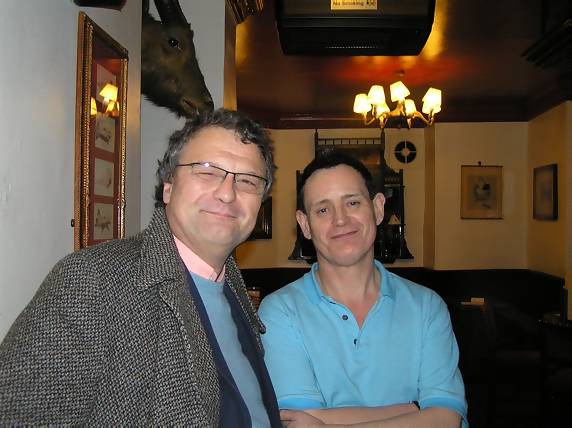
Two men, four names. Kelvin Carter / James Ross, left, and Stuart Russell / Nigel Harris at Radio Caroline's 45th birthday party in a London pub, March 2008. More photos from the event
here.
|
JR: When Caroline was off the Dutch coast, there was very good communication. Then the Mi Amigo moved to the UK. At the time, Radio Mi Amigo was making a lot of money and was ploughing a lot of money into the Mi Amigo
ship and there were regular tenders, regular Dutch tenders. Then, after a year or two, late '76, early '77, I can't remember exactly when, the frequency of the tenders dropped considerably. There were no mobile phones. There were no
walkie talkies because we were about 12 miles from the coast and there was limited communication with land. We thought, well, what if there is an emergency? How could we communicate? We had this wizard idea. I was presenting six till
nine in the evening and at eight o'clock, we would give out a list of numbers. Now, the numbers originally lasted from one to twenty five and each number explained what the problem was or what we needed. So let's say, for instance, ten
was we're in dire need of water. Eleven was we need food. Twelve was we needed diesel. And then as the numbers got higher, they became more and more specific to such an extent that we would have a couple: we urgently need milk because
the tea is really horrid! But if we didn't need anything, we couldn't not give out any numbers so numbers one to nine inclusive meant there were no problems. To make it slightly more interesting, occasionally we would give out
two numbers between one and nine so there was some continuity in giving more numbers, and it seemed to work. Originally, it was it was just twenty five numbers of which only the latter 15 meant anything specific. Numbers one to nine
were nothing. As time moved on, the codes expanded and expanded and expanded to an extent that, after a couple of years, there were 100 numbers - and it worked. You'd read out the numbers and on the next tender, things would
miraculously appear. And there was one occasion when the top of the mast fell off and we did this announcement saying last night in high seas, the top of the mast fell off and here are some numbers: number 16, 17, 24 and 25 which
basically meant send out an engineer quickly. We have huge technical problems.
There might be rough seas and freezing temperatures but all is well on the Mi Amigo. James only has one low number to read out for the office at 8pm on 19th February 1978. This recording courtesy of www.azanorak.com with thanks to Ray Robinson (duration 1 minute 41 seconds)
|

