|
|
|
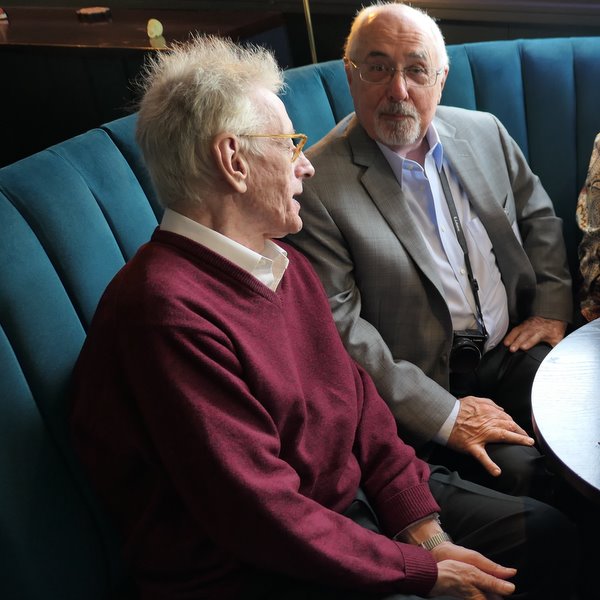
George Saunders, left, and John Lumsden at the Offshore 50 reunion in August 2017. John was chief engineer for Radio Scotland. Photo courtesy of Martin van der Ven.
|
Ray Clark has interviewed numerous people involved with Radio Caroline for documentaries and for his book, Radio Caroline: The True Story Of The Boat That Rocked (reviewed here).
One of his interviews was with engineer George Saunders who worked for both Radios Atlanta and Caroline.
The conversation was long and wide-ranging. We have edited it for publication.
George had been working for Marconi, joining the Atlanta project just before the station launched. He was on board as Atlanta merged with Radio Caroline and left soon after its ship, mv Mi Amigo, was washed up on the British coast.
He then went to work in Africa for the station he mentions in this interview. On his return to the UK, he was taken on by the BBC where he remained until retirement.
We are grateful to Ray for sharing this recording with us.
HOW DID YOU GET THE JOB?
GEORGE SAUNDERS: I went into a pub in Chelmsford one night and this pub was known to be frequented by Marconi people. It was quite crowded, I remember, and there was a chap sitting by himself. To me he looked
quite old. In fact, he was probably in his late 60s or something like that so I asked him, could I join him, and he said, yes. So I bought my pint and sat down and we started having a chat. It was all very friendly and he asked me
what I did in the company. So I told him that I'd been on broadcast transmitter development and we had just finished our baby, the highest-powered shortwave transmitter that had been built in Britain at that time. So we'd finished
that, it was ready to go into production and I was now writing. I'd been transferred, and I was writing a handbook on a marine radar system. So we had a laugh about that. Then he came back to broadcasting and transmitters, and he
went over what I knew and so on and so on. All of a sudden he said to me, “you sound just like the right sort of person I could use. I've got a project.” So I said, “oh, yes, I'm very interested”. So he
said, “whatever your Marconi salary is, we'll double it”. So I said,” ooh. What is it?” He said, “we're going to bring commercial radio to Britain”. So I expressed interest in it and he said
“OK. See how soon you can get away from the Marconi company, you know, how soon can you leave them? Let me know, and I will then give you further instructions.” I had to give him a ring. The number was Dunster 456. I
can remember that. I rang him up and told him. He said “you're going to receive a package through the post. It's going to be an airline ticket to Dublin and you're going to go to Dublin, and then go to Amiens Street Station.
You're then to get on a particular train that leaves at a given time. You're going to go on the Belfast line to Dundalk. And at Dundalk, you will be met by somebody you know.” So I said, ”oh, all right, OK, fair
enough”. So the package came through the post. I'd left Marconi. The package came through the post, and I did what was required. And when I got to Dundalk, there he was, standing by the exit. (laughs) So we got in the car,
and he said, “there's somebody else I want you to meet, Mr. Thomas.” It seemed a very long way but we went to a place called Greenore. And it looked closed down, a closed down railway
terminus and it had a big hotel there. Something was going on there. I didn't know what. There were two ships and one looked like a real ship, so to speak. The other looked like a coaster but the interesting thing about them was
that they both had very tall masts. So I thought, “well, that's interesting”. The buildings at Greenore, they looked just as though they'd been left. Somebody just walked out years ago. The adverts were still there and
so on. In fact I felt rather uneasy about the place actually. So anyway, we went on board the ship, my ship, which was the coaster, and went downstairs. And in one of the cabins downstairs there was a chap sitting there. And I took
one look at him and called him sir. You know, there was just something about him. And I was introduced to him and he then gave me the hardest technical interview I had in the whole of my career. It really was very, very thorough.
And all of a sudden, he said, right, he'll do. And that was it. So then we went for a walk. Now, the other chap whom I met in Chelmsford, his name was John Gilman. I found that out. And so all three
of us had a look around the ship, which was called the Mi Amigo. We looked at the studio gear and so on, and the transmitters, two of them, 10 kilowatts each. So he said, “right, now, you will be in charge on the ship and we've
got somebody to help you with the studio gear. You will teach him about the transmitters and he will teach you about the studio gear. And that should work out.” So I said, “OK, thank you very much”. So we had further
discussions about one or two other points and eventually I made my way back to Dundalk, and I came home again. I was told to wait for a telegram, and that would tell me where I had to go. So I waited, and eventually I had a telegram
telling me to go to Brightlingsea on such and such a date. I did and there was a boatyard there. There was a gravel barge offshore, or just off, called the Cecil Gilders. I don't know if you know what a gravel barge looks like, but
the accommodation is pretty rough. You have to get into the hold, basically, and that's it. So we went out to this gravel barge in a small boat, and got on board. Then we went out to sea and I saw the ship that I'd seen in Greenore.
There she was. So I scrambled on board. We had a Dutch crew, quite nice people, quite reasonable, and I was told “check everything over and, when everything is ready to go, come on the air and broadcast a tape”. And I
said, “okay”. So one night we played the tape, and that was it. No DJs, of course, we were all tape (at the start). A couple of other people joined us on the technical side. They both knew John Gilman, and were both ex-BBC.
That was interesting and they were ex-transmitter people so that made life a lot easier. We were then on the air as Radio Atlanta.
DISC-JOCKEYS ON BOARD
|
|
|
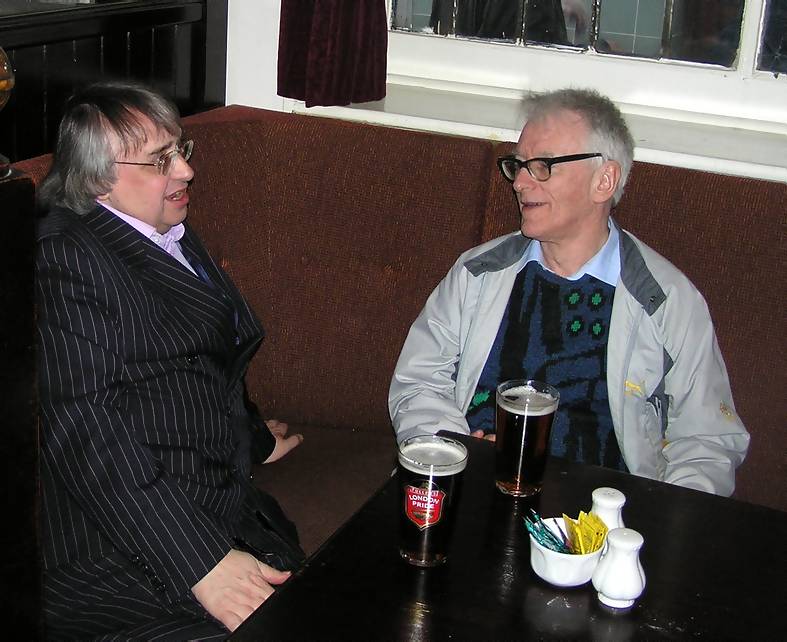
Paul Rusling, left, with George Saunders at Radio Caroline's forty-fifth birthday party.
|
We were doing the tapes and all the rest of it and I remember one night, we had a religious programme to do. This was the last thing before we closed down. It was on the thinnest tape you could possibly imagine.
It was absolutely bloody cheap tape and the tape got wrapped around the innards of the tape recorder and stopped. (laughs) And, of course, I didn't know this, but the agents for the religious programme were on shore listening to what
was going on. We had the old Radio Nord record library on board in tea chests so I said to the other chap who was with me “grab a handful of 45s.” (We had to fill the dead air.) Of course I didn't know what was coming
next at all. I hadn't got the slightest idea but I tried to make some sort of programme out of it. I was very glad when we closed down at eight o'clock at night. Well (Managing Director) Allan Crawford came
down to see us to see what had gone wrong. He said, “now tell me, George, what can we do to prevent another programme like yours from being broadcast?” So I laughed and I said, ”well, perhaps if we had a DJ on board
with, say, the top 50 records or something, that might help.” So he said, “yeah, all right”. So from then onwards, we had a DJ on board with, I think, 50 or something like that records, you know. And if anything
went wrong, he could, you know, fill in.
A PROBLEM WITH TAPED SHOWS
On another occasion we had a really horrible shock. The case containing all the tapes came out and they were very, very badly modulated. You played the tape, you know, normal and then the volume suddenly went down
to zero, and then it came back again and zero again and so on. So, of course, that meant an urgent message to shore, on our radio telephone link. We got another set of tapes out very quickly, fortunately, and the inquiry was, what had
happened to the other ones. And it turned out that, of course, everything had to go through Customs, you see, and Customs at Colchester had apparently put these tapes on some sort of electric (device) ... Now, we were not sure whether
this was an accident that had happened, a genuine accident, or whether they'd done it deliberately. We weren't quite sure about that but it probably was just an accident.
TRANSMITTER CRYSTALS
At Greenore, Continental Electronics sent us four crystals. Two were for 1511 kHz, and the other pair was for 1520 kHz. All four ended up on the Fredericia, and the Fredericia would not give them to us.
They wouldn't give us our pair of crystals until some time afterwards and, you know, we were there, waiting, all ready to go. They (Caroline) had come up on 1511. Now, 1511 was the same frequency as a station in Belgium and it caused
serious interference. Now, the Belgians are not people to be trifled with in matters like this at all. They immediately complained to the ITU. Basically, they raised hell. They complained to the Panama people, the registration people
for the ship, and Panama immediately withdrew the registration. I think the same thing happened on the Mi Amigo as well. I'll tell you how I know this. When I was at Greenore, just afterwards, the ship's radio call sign was Hotel Oscar
Juliet Whiskey which is a Panamanian call sign. The Caroline ship was HPRN, which is also Panamanian. After that our call sign changed. I found this out by looking in Lloyd's Register of Shipping and it was no longer H-O-J-W. It was
something else. So I quietly assumed that we'd been re-registered in another country like Guatemala. It was either Honduras or Guatemala, one of those. So eventually, they (the Caroline people) decided to give us a pair of crystals.
And they moved to 1520, which was where we should have been. And, of course, they kept one 1520 crystal on their ship, and they gave us another one and the agreement was that they would close down at 6 o'clock in the evening. We would
come on 6 o'clock until 8 o'clock in the evening and go off at 8. That was the arrangement.[1] And it worked. You know, after a fashion, it did work but, of course, then we had to find another frequency.
And this is, I think, where Mr. Thomas came in very useful because he knew people who worked at BBC Tatsfield, the monitoring station, and I think Tatsfield advised him of a new frequency, 1493 kHz. Then we had to get a crystal made
for 1493 and that took some doing. So there you are, we were on the air.[2]
|
|
|
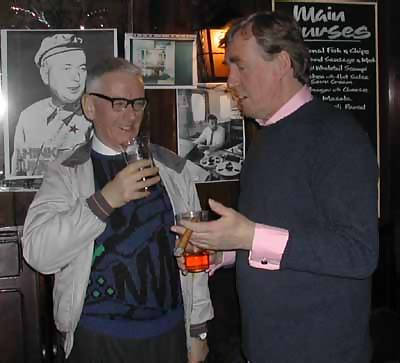
George Saunders, left, with Simon Dee at Radio Caroline's fortieth birthday party, 28th March 2004.
|
THE MERGER OF CAROLINE AND ATLANTA, 2nd JULY 1964
This large tugboat or whatever it was came alongside us. Simon Dee was on the deck with his wife and child, I think, and Doug Kerr was there. They
came on board and said “we're now one station and you're going to come on the air tomorrow morning as Radio Caroline South, etc., etc.” There was no paperwork for this, by the way, at all. You know, nothing, no proof.
Simon Dee, oh, gosh, he was very, very touchy. He really was. Doug Kerr was far more friendly and I got on very well with him. We had to change things around a bit to be ready to come up as Radio Caroline South at 6 o'clock the
following morning, which we did, and from then on, that was all right. We then got all the rest of the people on board and life changed completely. It really did.
RADIO CAROLINE NORTH
I had to go up to the Fredericia some time afterwards. She was off the Isle of Man and was in a hell of an engineering state. I went up there and, when I found out what had gone on, frankly, I was livid. You name
it, it was wrong. They only had one transmitter working, and that was in a rather poorly condition. The other transmitter had been raided for spares. Now, all this stuff was only about three months old, by the way, brand new equipment.
And the studio was in a similar mess. The bloke who was there, Ove Sjöström, he claimed that he knew everything, etc. etc. and, of course, he didn't. That was quite obvious because I gave
him an interview, in effect. He didn't like it at all but he couldn't answer the questions. So I recommended to John Gilman that he should be replaced. And John then said to me, well, I'm afraid you'll have to stay on until you've
resolved all the problems (laughs). They had a secret radio telephone link, just like we had, to shore so I was able to order spares and bits and pieces, and I worked on it all. Gradually it all came back. The damage that had been done
to it was absolutely incredible. I found out the reasons why and that got me even angrier. It was down to whoever had done the installation work. It's difficult to explain this without being too technical. It's a three-phase input,
like the public electricity supply. Normally you want 220 volts on the transmitter, for the transformer and so on, and you wanted 115 volts for the other bits and pieces inside the transmitter. You also wanted 115 volts for all the
studio equipment. That was all American stuff and it ran on 115 volts. Now, we derived our 115 volts the sensible way, which is to have a transformer, 220 volts on the primary, 115 volts on the secondary, and away we go. That's how
the Mi Amigo did it. No problem at all. But, of course, if you are into power supply street distribution systems, then it's a different method altogether. And this is what they had done. And this is why, in fact, if you took a meter
reading in the studio, the voltage was nowhere near 115, it was more like 130. And, of course, that burned things out. And, oh, gosh, you know, I really was bloody livid. I can remember it even now, actually. So it may not have been
entirely Sjöström's fault but, as soon as he put a voltmeter across to see what was happening in the studio, that should have alerted him straight away and if he'd sent down a very urgent message to London, something's gone,
something's wrong, etc., etc., well, somebody would have come up and sorted it out for him and he would still have been on board. But there you are.
|
|
|
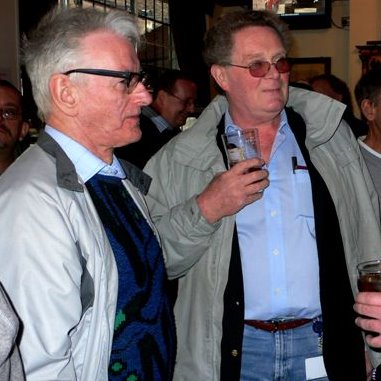
George Saunders, left, with Mi Amigo studio engineer Patrick Starling at Radio Caroline's forty-fifth birthday party. Photo courtesy of Sylvan Mason.
|
THE DIFFERENCE BETWEEN THE SHIPS
I was quite glad to come back to the Mi Amigo. It was a far more comfortable ship. I always felt a bit seasick on the Fredericia. It had a very slow roll, very slow, and it was just slightly off-putting. I didn't
like it. Now, I'm not a seaman by any means, but I did wonder about the stability of the ship. I really did. I was very glad to get back to the Mi Amigo. I really was. So, that was that, but I had to stay on board (the Fredericia)
until two new people came up to replace me. And they were decent people. They knew what they were doing. And that was the end of that, thank goodness.
THE GROUNDING OF THE MI AMIGO[3], 19th January 1966
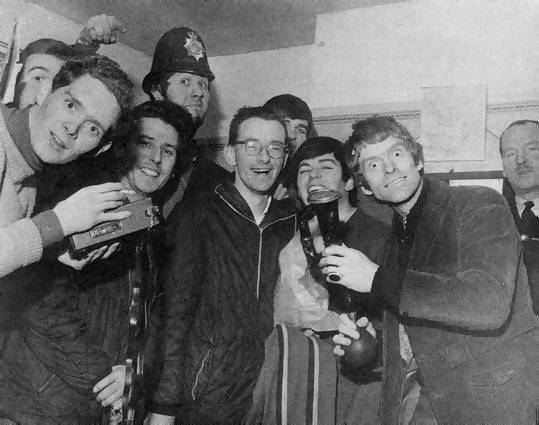
I was on board the night we went aground. Some time ago, I was on a Radio Berkshire broadcast about this with Tony Blackburn, who was also there. We were all taken off by breeches buoy.
This was the last breeches buoy rescue ever in Britain, by the way. The night was absolutely awful. Snow and cold and very high winds and all the rest of it so, of course, all the technical people had to abandon ship. Tony was the
first one ashore. And he was also the youngest in the radio crew so, for this Radio Berkshire broadcast, I said to him, “Tony, you do realise we followed a very ancient custom of the sea that night”. So, he said,
“oh, what was that?” I said, “women and children first”. (laughs) He didn't like it.
|
|
|
Following the ship's grounding, the rescued DJs and engineers pose at the police station. George, in glasses, is in the middle, next to Tony Blackburn. Photograph from ‘Radio Caroline’, published by MRP Books.
|
CAROLINE HELPS THE GOVERNMENT
The new transmitter, serial number 12 had been paid for by Philip Solomon, who was a music entrepreneur or something in Ireland, and he had decided to pay for it. Radio London, which had
been running on 17kW for quite a long time, had suddenly found that they could get up to 50kW and their signal strength was far more powerful in London than ours. We had tried combining our two transmitters but our combiner gave us
all sorts of problems, like you couldn't put the kettle on in the mess room if you wanted to have a cup of tea because the generators wouldn't stand the extra load, etc., etc. (laughs) It worked technically, but it wasn't very
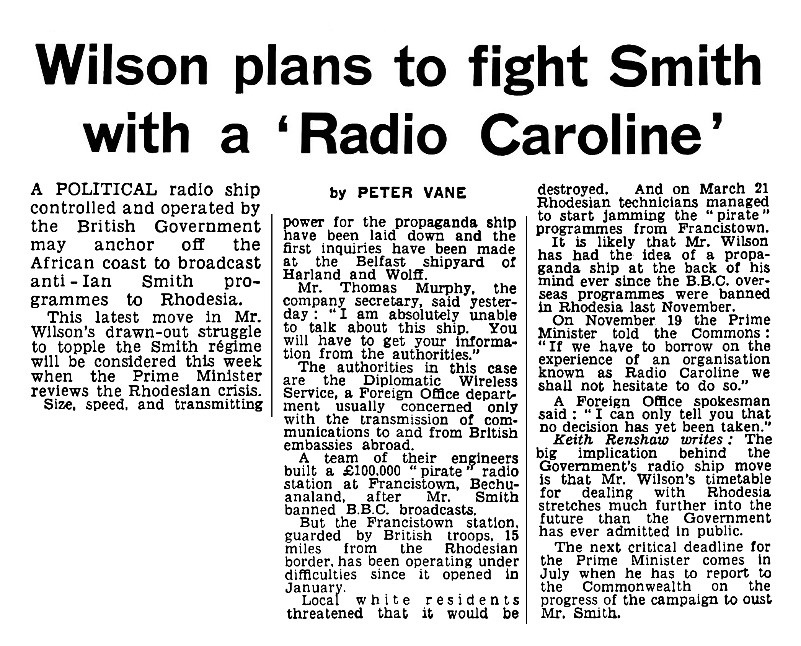
successful from a practical point of view. We had to have a new transmitter. Now of course, while all this was going on, Rhodesia declared UDI (Unilateral Declaration of Independence) on the 11th of November 1965. Ian Smith was the
Prime Minister and he was very, very right wing. Until then Radio Rhodesia had broadcast the BBC, General Overseas Service I think it was called in those days, they'd done news bulletins at certain times of the day. But when UDI was
declared, they stopped doing that and it was decided at a very high level (in the British Government) that something should be done. Thomas, Gilman and myself had talks in Caroline House with people from the Foreign Office, and they
put forward to us that they wanted a ship off Mozambique. We told them that wouldn't work, and we told them all the reasons why. So they said, okay, well, we'll find something else and be in touch. Well, Bechuanaland, as
was[4], was going to become independent fairly soon and something could be done in the way of economic aid. It was decided, talking to the government, that yes, Britain could give them a new broadcasting
station. The site chosen was Francistown. They had two 50 kilowatt transmitters: serial number 12 and serial number 13 from Continental Electronics[5] plus a Marconi 10 kilowatt operating on one of the
tropical bands, 60 metres.
|
|
|
Sunday Express cutting, 3rd April 1966, courtesy of ‘Offshore Echos’ magazine.
|
NOTES
|
|
On 9th May 1964, see here.
|
|
|
On 12th May 1964.
|
|
|
George's account of this incident is here.
|
|
|
It is now called Botswana.
|
|
|
The 50 kilowatt transmitter which Radio Caroline had ordered from Continental Electronics was diverted to Africa. The station had to wait for the next one off the production line, serial number 14.
After the transmitters had finished operating in Africa and been brought back to the UK, one of them was used to jam Radio Northsea International in 1970 (see here).
|
Back to Ray's conversation with James Ross.
His interview with Atlanta, Caroline and Scotland DJ Bryan Vaughan is over the page.
|

