|
|
The Pirate Radio Hall of Fame needs your
|
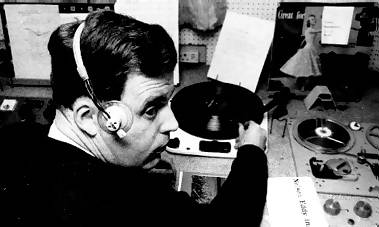
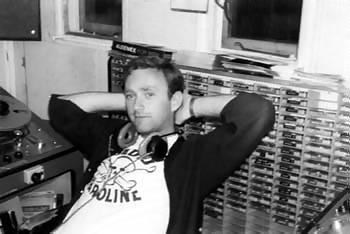 Gordon Cruse was born in Calgary, Canada, in 1942. He joined Radio Caroline South as a newsreader in August 1966 before transferring to the Caroline North ship. Here he
continued to read the news but also presented programmes. Gordy stayed with Caroline until March 1967 and then returned to Canada. We asked if anyone could fill us in on his later career and, in November 2001, we heard from the
man himself: “Greetings to all! This is Gord Cruse from Victoria BC Canada! I am alive and well and just retired from a 26 years stint at the Victoria Youth Custody Center... and I was quite excited at finding me in
The Pirate Radio Hall of Fame. A brief history to update ... left Radio Caroline North in March of '67, travelling back to Canada via London, Rome, Athens, Cairo, Kuwait, New Delhi, Hong Kong,
Honolulu and Vancouver. I returned to CFQC Radio in Saskatoon doing programmes and commercials until March of '68 when I again travelled - this time to Australia. A year down under and back to Canada stopping in Victoria to see a
broadcast friend landed a job at C-FAX 1070 as operations / music director in the summer of '69. In the summer of '76 I began work in the Victoria Youth Custody Center as a youth supervisor. As of spring 2002 I am retired and will
be enjoying one of those great government superannuations and living life to its fullest.... Wonderful to be part of this.” Gordon wasn't idle after retiring. He wrote two books on the Canadian juvenile penal system:
Juvie: Inside Canada's Youth Jails was followed by Handcuffed by History: Young Offenders After Juvie - 40 Years in Their Words. Gordon attended the First North American Pirate Radio Reunion in Vancouver, Canada, and the Offshore 50
reunion in London. There is a photo of Gord on the Caroline North tender in Nick Bailey's photo album, one of him on shore-leave with engineer Bob Read
here and one with Tony Prince here. We also have his memories of Caroline. Sadly Gordy passed away after suffering a heart attack on 13th March
2026. (Many thanks to Gordon for providing the photo.)
Gordon Cruse was born in Calgary, Canada, in 1942. He joined Radio Caroline South as a newsreader in August 1966 before transferring to the Caroline North ship. Here he
continued to read the news but also presented programmes. Gordy stayed with Caroline until March 1967 and then returned to Canada. We asked if anyone could fill us in on his later career and, in November 2001, we heard from the
man himself: “Greetings to all! This is Gord Cruse from Victoria BC Canada! I am alive and well and just retired from a 26 years stint at the Victoria Youth Custody Center... and I was quite excited at finding me in
The Pirate Radio Hall of Fame. A brief history to update ... left Radio Caroline North in March of '67, travelling back to Canada via London, Rome, Athens, Cairo, Kuwait, New Delhi, Hong Kong,
Honolulu and Vancouver. I returned to CFQC Radio in Saskatoon doing programmes and commercials until March of '68 when I again travelled - this time to Australia. A year down under and back to Canada stopping in Victoria to see a
broadcast friend landed a job at C-FAX 1070 as operations / music director in the summer of '69. In the summer of '76 I began work in the Victoria Youth Custody Center as a youth supervisor. As of spring 2002 I am retired and will
be enjoying one of those great government superannuations and living life to its fullest.... Wonderful to be part of this.” Gordon wasn't idle after retiring. He wrote two books on the Canadian juvenile penal system:
Juvie: Inside Canada's Youth Jails was followed by Handcuffed by History: Young Offenders After Juvie - 40 Years in Their Words. Gordon attended the First North American Pirate Radio Reunion in Vancouver, Canada, and the Offshore 50
reunion in London. There is a photo of Gord on the Caroline North tender in Nick Bailey's photo album, one of him on shore-leave with engineer Bob Read
here and one with Tony Prince here. We also have his memories of Caroline. Sadly Gordy passed away after suffering a heart attack on 13th March
2026. (Many thanks to Gordon for providing the photo.)
 Gordy Cruse reading the 5pm news on Radio Caroline North from 20th September 1966. It was the day of the on-air wedding of his fellow DJ Mick Luvzit to Janet Terrett. The
voice at the start of the clip belongs to Tony Prince and the bulletin also features Graham Webb who later provided a commentary to the wedding
ceremony. With thanks to Steve Kirby for the tape (duration 2 minutes 4 seconds)
Gordy Cruse sitting in for Bob Stewart, lunchtime on 12th March 1967. Recording kindly provided by John Thomas (duration 3 minutes 26 seconds)
Gordy Cruse reading the 5pm news on Radio Caroline North from 20th September 1966. It was the day of the on-air wedding of his fellow DJ Mick Luvzit to Janet Terrett. The
voice at the start of the clip belongs to Tony Prince and the bulletin also features Graham Webb who later provided a commentary to the wedding
ceremony. With thanks to Steve Kirby for the tape (duration 2 minutes 4 seconds)
Gordy Cruse sitting in for Bob Stewart, lunchtime on 12th March 1967. Recording kindly provided by John Thomas (duration 3 minutes 26 seconds)
 Brian Cullingford was working for the BBC as an interviewer on Today and other programmes when his attention was grabbed by an advertisement
for a new and different pirate station. It was King Radio, soon to be transformed into the mightier Radio 390. He auditioned, and was accepted as presenter. Initially he used the name Bruce
Ford. He remembers: “when cutting our teeth on King, we were encouraged to adopt temporary persona and then re-invent ourselves on 390. The short lived and mysterious Bruce Ford was me!”
When the programme controller, R&B expert Mike Raven, discovered that, in a previous incarnation, Brian had been a Merchant Navy officer, he invited him to take on the
additional role of Fort Captain (offshore equivalent of Station Manager) adding mysteriously “bring your navy uniform, it may be useful.” The comment proved to be prophetic. Brian describes his
new home as follows: “Red Sands fort actually comprised seven forts, former anti-aircraft installations linked together precariously by swinging catwalks. We were ferried from Whitstable in the tender
skippered by our fisherman/agent and winched up singly to the towering towers above. The basic facilities were primitive (and included loos which were simply holes in wooden seats poised 65ft above the waves)
but everything was soon improved. A magnificent transmitter was installed, an enormous aerial mast erected, and studio, record library and staff accommodation were all updated.” The broadcasting style
of 390 was rather correct and formal, and Brian insists that the presenters were instructed to “speak like announcers on the BBC Home Service ten years ago”. Each of them presented up to six
programmes a day, between 6.30am and midnight, with durations ranging from 15 minutes to 2 hours. Brian enjoyed the variety - trad jazz, country & western, popular classics, request shows, even programmes
for children. Radio 390 quickly gained an enthusiastic army of listeners of all ages and fan mail began to arrive by boat, along with essential stores and relief staff. Brian tells us that “a few
listeners actually came out (8 miles) to see us, and one sunny Sunday we were hailed by the crew of a power boat, who challenged us to go water skiing. Conditions were perfect, with the sea as calm as the
proverbial millpond, and Mark Hammerton and I took grateful advantage of the offer and enjoyed showing off our aquatic prowess.” Brian goes on “Although the station
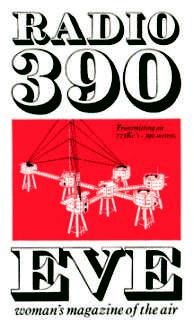
was enjoying success and its unusual style and programming, including ‘Eve, The Women's Magazine of the Air’ was obviously meeting a need, we had to be aware of the Government's hostility to the
pirates and there was even talk of the RN being used to close us down. One very foggy day I was called from my cabin with the cry ‘Brian, the Navy's here. You'd better come. Could you wear your uniform?’
Armed with peaked cap and gold braid, I peered into the gloom and saw the ominous grey shape of a warship slowly circling the forts. So this was the end. Well, we had been warned. As they came closer and closer,
we began to hear the muffled sound of a loud hailer. What on earth were they saying? Was it ‘Close down your transmitter immediately’ or perhaps ‘We are about to come aboard. Do not resist’
or perhaps it was ‘Take cover, we are going to open fire’. They circled even closer and closer and at last we could understand the message. ‘Could you play us a record by the Rolling Stones?’”
Brian also recalls the occasion when ITV's Danger Man, Patrick McGoohan, arrived on 390 with other actors and a film crew to make an episode about a pirate radio station. (See Edward
Cole's photo album.) He says “We couldn't resist teasing our visitors when they were spotted en masse exploring the one fort still not in use (allegedly reserved as a future weekend pad for the directors).
Grabbing a loud hailer, I called out to them as sternly as possible ‘Gentlemen, you are in extreme danger. That fort is unsafe and strictly out of bounds. And the connecting catwalk has been condemned.
I want you to come back along it extremely slowly and carefully, and ... one .. at .. a.. time.’ I am ashamed to say that we hardened Redsanders thoroughly enjoyed the spectacle of Danger Man and his
quaking colleagues tiptoeing nervously and gingerly to safety.” He remembers “Offshore radio was regarded as exciting news and I suspect that some journalists imagined stationary forts in the Thames
Estuary to be easier to board than pirate ships bouncing about in the North Sea. So we attracted a few press visitors and I was sometimes instructed by head office to show them round. I was horrified when the
Daily Mail did a feature on me and described me as ‘the Gentleman Pirate’. I was proud of being a pirate, but who wants to be a gentleman?” In 1966 Brian was teamed up with
Dominic Le Foe to produce The Voice of Business, believed to be the first ever radio programme devoted to commercial subjects. It was a great success and was on the air five
evenings a week plus a weekend omnibus edition. Also involved in the programme was Leslie Mitchell, the first man in the world ever to be seen on television - in 1936! Following his Radio 390 days Brian worked
widely for BBC television and radio and on ITV. Series included Night Ride, What The Papers Say, Movie-Go-Round, Songs of Praise, How About You? and Nationwide. When Jonathan Dimbleby resigned
from BBC's regional current affairs programme Points West, Brian was chosen as his replacement. He was later Managing Director of Catalyst World Class Ltd., a company which provided speakers, entertainers and
musicians for events around the world. There are some more recent photos of Brian, taken at the Radio Academy Celebration of Offshore Radio in August 2007, here. (Our thanks to Brian for getting
in touch, telling us about his offshore career and for his kind comments. He wrote “I have just come across your splendid Hall of Fame and am amazed by the effort obviously put in to keep alive the memories of an exciting,
important and rather bizarre phase in the history of broadcasting. I guess we were true pioneers in changing attitudes of the public and, eventually, the government, to more creative use of the airwaves.” Brian has also
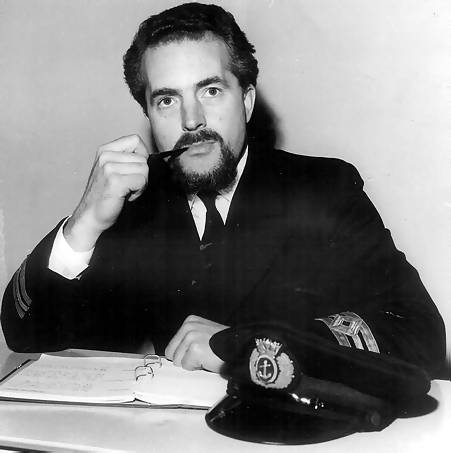
kindly provided this photo, taken in his cabin on Red Sands. He is in his Fort Captain's uniform, as mentioned above.)
Brian Cullingford was working for the BBC as an interviewer on Today and other programmes when his attention was grabbed by an advertisement
for a new and different pirate station. It was King Radio, soon to be transformed into the mightier Radio 390. He auditioned, and was accepted as presenter. Initially he used the name Bruce
Ford. He remembers: “when cutting our teeth on King, we were encouraged to adopt temporary persona and then re-invent ourselves on 390. The short lived and mysterious Bruce Ford was me!”
When the programme controller, R&B expert Mike Raven, discovered that, in a previous incarnation, Brian had been a Merchant Navy officer, he invited him to take on the
additional role of Fort Captain (offshore equivalent of Station Manager) adding mysteriously “bring your navy uniform, it may be useful.” The comment proved to be prophetic. Brian describes his
new home as follows: “Red Sands fort actually comprised seven forts, former anti-aircraft installations linked together precariously by swinging catwalks. We were ferried from Whitstable in the tender
skippered by our fisherman/agent and winched up singly to the towering towers above. The basic facilities were primitive (and included loos which were simply holes in wooden seats poised 65ft above the waves)
but everything was soon improved. A magnificent transmitter was installed, an enormous aerial mast erected, and studio, record library and staff accommodation were all updated.” The broadcasting style
of 390 was rather correct and formal, and Brian insists that the presenters were instructed to “speak like announcers on the BBC Home Service ten years ago”. Each of them presented up to six
programmes a day, between 6.30am and midnight, with durations ranging from 15 minutes to 2 hours. Brian enjoyed the variety - trad jazz, country & western, popular classics, request shows, even programmes
for children. Radio 390 quickly gained an enthusiastic army of listeners of all ages and fan mail began to arrive by boat, along with essential stores and relief staff. Brian tells us that “a few
listeners actually came out (8 miles) to see us, and one sunny Sunday we were hailed by the crew of a power boat, who challenged us to go water skiing. Conditions were perfect, with the sea as calm as the
proverbial millpond, and Mark Hammerton and I took grateful advantage of the offer and enjoyed showing off our aquatic prowess.” Brian goes on “Although the station
was enjoying success and its unusual style and programming, including ‘Eve, The Women's Magazine of the Air’ was obviously meeting a need, we had to be aware of the Government's hostility to the
pirates and there was even talk of the RN being used to close us down. One very foggy day I was called from my cabin with the cry ‘Brian, the Navy's here. You'd better come. Could you wear your uniform?’
Armed with peaked cap and gold braid, I peered into the gloom and saw the ominous grey shape of a warship slowly circling the forts. So this was the end. Well, we had been warned. As they came closer and closer,
we began to hear the muffled sound of a loud hailer. What on earth were they saying? Was it ‘Close down your transmitter immediately’ or perhaps ‘We are about to come aboard. Do not resist’
or perhaps it was ‘Take cover, we are going to open fire’. They circled even closer and closer and at last we could understand the message. ‘Could you play us a record by the Rolling Stones?’”
Brian also recalls the occasion when ITV's Danger Man, Patrick McGoohan, arrived on 390 with other actors and a film crew to make an episode about a pirate radio station. (See Edward
Cole's photo album.) He says “We couldn't resist teasing our visitors when they were spotted en masse exploring the one fort still not in use (allegedly reserved as a future weekend pad for the directors).
Grabbing a loud hailer, I called out to them as sternly as possible ‘Gentlemen, you are in extreme danger. That fort is unsafe and strictly out of bounds. And the connecting catwalk has been condemned.
I want you to come back along it extremely slowly and carefully, and ... one .. at .. a.. time.’ I am ashamed to say that we hardened Redsanders thoroughly enjoyed the spectacle of Danger Man and his
quaking colleagues tiptoeing nervously and gingerly to safety.” He remembers “Offshore radio was regarded as exciting news and I suspect that some journalists imagined stationary forts in the Thames
Estuary to be easier to board than pirate ships bouncing about in the North Sea. So we attracted a few press visitors and I was sometimes instructed by head office to show them round. I was horrified when the
Daily Mail did a feature on me and described me as ‘the Gentleman Pirate’. I was proud of being a pirate, but who wants to be a gentleman?” In 1966 Brian was teamed up with
Dominic Le Foe to produce The Voice of Business, believed to be the first ever radio programme devoted to commercial subjects. It was a great success and was on the air five
evenings a week plus a weekend omnibus edition. Also involved in the programme was Leslie Mitchell, the first man in the world ever to be seen on television - in 1936! Following his Radio 390 days Brian worked
widely for BBC television and radio and on ITV. Series included Night Ride, What The Papers Say, Movie-Go-Round, Songs of Praise, How About You? and Nationwide. When Jonathan Dimbleby resigned
from BBC's regional current affairs programme Points West, Brian was chosen as his replacement. He was later Managing Director of Catalyst World Class Ltd., a company which provided speakers, entertainers and
musicians for events around the world. There are some more recent photos of Brian, taken at the Radio Academy Celebration of Offshore Radio in August 2007, here. (Our thanks to Brian for getting
in touch, telling us about his offshore career and for his kind comments. He wrote “I have just come across your splendid Hall of Fame and am amazed by the effort obviously put in to keep alive the memories of an exciting,
important and rather bizarre phase in the history of broadcasting. I guess we were true pioneers in changing attitudes of the public and, eventually, the government, to more creative use of the airwaves.” Brian has also
kindly provided this photo, taken in his cabin on Red Sands. He is in his Fort Captain's uniform, as mentioned above.)
Clips from two programmes presented by Brian Cullingford on Radio 390. These recordings have kindly been provided by Dickie Bird (duration 1 minute 7 seconds)
Brian Cullingford presents Radio 390's programme for children, Playtime, on 16th February 1967. Recording kindly provided by Hans Knot (duration 2 minutes 28 seconds)
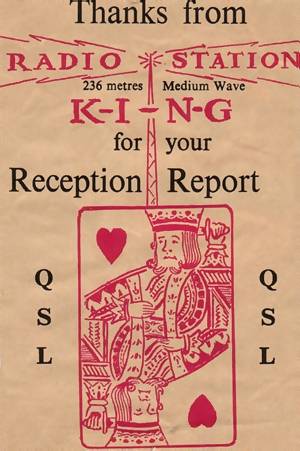
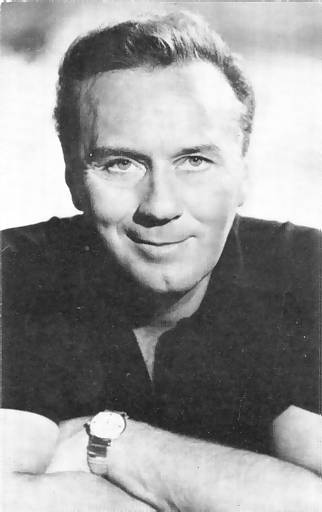
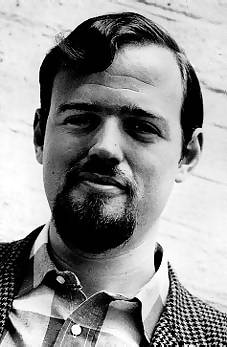 Jack Curtiss Born on 16th June 1943 in San Francisco, California, Jack had worked for the UPI news agency before getting into radio. He broadcast on stations KMPX, KWG and
KONG, all in California, as well as WROV in Roanoke, Virginia, before heading for Europe. He joined the Britain Radio / “Swinging” Radio England operation
in July 1966. Initially he was expected to broadcast as “Bruce Wayne”. This, of course, was the name of Batman's secret identity. The Batman TV craze was big at the time and Radio England had just bought a set of
Batman jingles. Jack was not impressed: “They told me I would go on the air with this nifty jingle as ‘Bruce Wayne’. I did for one or two programmes and then told management that I had not abandoned a job I liked
very much in Virginia and crossed the Atlantic in order to disappear under some bogus fad jingle and that I'd sooner head back to the States. Bill Berry, who arrived the same weekend I did, likewise
refused to continue on the air as ‘Dick Grayson’ (Robin). I subsequently transferred over to Britain Radio and I seem to recall the Wayne jingle being used very briefly by Boom Boom
Brannigan before he settled down as B-B.” He was not the last Bruce Wayne though. Someone else used the name during the last few weeks of the station. Jack moved over to Britain Radio full
time, where he used his real name on air, and was promoted to General Manager in November that year. When Radio England closed down, he set up the Dutch station, Radio Dolfjin, that replaced it. In early 1967 Britain Radio was taken
over. A new Managing Director, Ted Allbeury, arrived from Radio 390 and he relaunched the station under the new name of Radio 355. There was little love lost between the two and Jack, who had been
quoted in the press making derogatory remarks about 390's “stone age” format, resigned. He returned to San Francisco and became programme director of KFOG-FM radio. He did a similar job for two other San Francisco area
radio stations before moving to Puerto Rico in December 1968. He stayed on the island for five years, working in radio, TV, magazines and newspapers. In 1974 he moved to France and was a radio correspondent for CBS news, also
being heard on Radio Netherlands and the Voice of America. In 1978 he joined VOA full-time as Latin America Bureau Chief. This led to Jack becoming Latin America correspondent for ABC News. In 1982 he returned to the USA and settled in
Florida. He was Health and Science Editor for WTVJ-TV in Miami before helping set up a public television bureau in Broward County, Fort Lauderdale for WPBT-Channel 2. He then worked as a writer and media consultant in south Florida.
In 2004 he moved to Australia and lived in Adelaide but later returned to the United States, setting up home in Seattle where he lived for the last 9 years of his life. He died suddenly of natural causes in July 2021, aged 78.
(Jack corresponded regularly with The Pirate Radio Hall of Fame and kindly provided some fascinating items of his memorabilia. There are also some pictures, taken with
his former Britain Radio colleague Harry Putnam, here. This promotional photo was issued by Radio England / Britain Radio in 1966.)
Jack Curtiss Born on 16th June 1943 in San Francisco, California, Jack had worked for the UPI news agency before getting into radio. He broadcast on stations KMPX, KWG and
KONG, all in California, as well as WROV in Roanoke, Virginia, before heading for Europe. He joined the Britain Radio / “Swinging” Radio England operation
in July 1966. Initially he was expected to broadcast as “Bruce Wayne”. This, of course, was the name of Batman's secret identity. The Batman TV craze was big at the time and Radio England had just bought a set of
Batman jingles. Jack was not impressed: “They told me I would go on the air with this nifty jingle as ‘Bruce Wayne’. I did for one or two programmes and then told management that I had not abandoned a job I liked
very much in Virginia and crossed the Atlantic in order to disappear under some bogus fad jingle and that I'd sooner head back to the States. Bill Berry, who arrived the same weekend I did, likewise
refused to continue on the air as ‘Dick Grayson’ (Robin). I subsequently transferred over to Britain Radio and I seem to recall the Wayne jingle being used very briefly by Boom Boom
Brannigan before he settled down as B-B.” He was not the last Bruce Wayne though. Someone else used the name during the last few weeks of the station. Jack moved over to Britain Radio full
time, where he used his real name on air, and was promoted to General Manager in November that year. When Radio England closed down, he set up the Dutch station, Radio Dolfjin, that replaced it. In early 1967 Britain Radio was taken
over. A new Managing Director, Ted Allbeury, arrived from Radio 390 and he relaunched the station under the new name of Radio 355. There was little love lost between the two and Jack, who had been
quoted in the press making derogatory remarks about 390's “stone age” format, resigned. He returned to San Francisco and became programme director of KFOG-FM radio. He did a similar job for two other San Francisco area
radio stations before moving to Puerto Rico in December 1968. He stayed on the island for five years, working in radio, TV, magazines and newspapers. In 1974 he moved to France and was a radio correspondent for CBS news, also
being heard on Radio Netherlands and the Voice of America. In 1978 he joined VOA full-time as Latin America Bureau Chief. This led to Jack becoming Latin America correspondent for ABC News. In 1982 he returned to the USA and settled in
Florida. He was Health and Science Editor for WTVJ-TV in Miami before helping set up a public television bureau in Broward County, Fort Lauderdale for WPBT-Channel 2. He then worked as a writer and media consultant in south Florida.
In 2004 he moved to Australia and lived in Adelaide but later returned to the United States, setting up home in Seattle where he lived for the last 9 years of his life. He died suddenly of natural causes in July 2021, aged 78.
(Jack corresponded regularly with The Pirate Radio Hall of Fame and kindly provided some fascinating items of his memorabilia. There are also some pictures, taken with
his former Britain Radio colleague Harry Putnam, here. This promotional photo was issued by Radio England / Britain Radio in 1966.)
A very short recording of Jack wishing the listeners of Britain Radio a Happy Christmas in 1966. This clip is from a recording of a Phil Martin Morning Serenade programme made available by
The Offshore Radio Archive (duration 21 seconds)
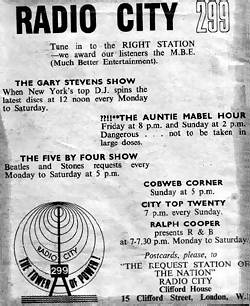
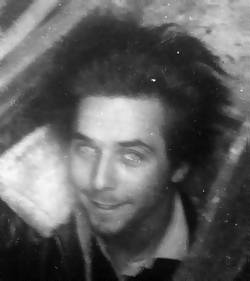 Cliff Cuttelle was born in Whitstable, Kent, in 1945. After finishing his education, Cliff started a six year apprenticeship with the local printing group, Elvey Bros.,
Cross and Jackman. While at school he had got to know Eric Martin's daughter. Eric (not the DJ of the same name) was Radio City's General Manager as well as owner of The Record Centre shop in Whitstable. Cliff says: “I seem
to remember that I had done some small printing jobs for Eric and he knew that I was an apprentice and, as such, did not earn much money. He asked me if I would like to go out to the (Shivering) Sands at Bank Holidays and the like,
when they sometimes had staff shortages”. Cliff agreed and for the next year or so would make occasional visits to Radio City. He remembers his first visit: “I was supposed to go out just as a general assistant, grease
monkey, cook and bottle washer. However, that was not to be the case. On the first trip to the forts, within a couple of hours, I was on the air. I remember sitting there, knees knocking, not knowing what to say but I got through.
I had some help from the others but I was really thrown in the deep-end and must have lost a couple of pounds that afternoon in weight!” Cliff's memories of the fort are that it was “cosy, warm, food was not bad, had
most of the home comforts. A lot of work had gone in to setting up the internals and it was still on-going. Due to the station's hectic days, food was taken on an as-and-when basis. To sleep, we had old army bunk beds. I got the
bottom one which was not a healthy place to be, as I found out!” Cliff remembers going out to the fort for the long Easter weekend of 1965 - and getting stranded: “I went out on the Thursday for four days. It was Easter
and someone had to work and money talked. Got out there OK but the seas were running quite strong and we knew that we were running into a gale that night. Everyone got on and off the Sands, as well as all the supplies. The boat was
due back out on the Monday afternoon and I should have been back working in the print shop on Tuesday morning. No way. The seas were too high for anything to leave Whitstable harbour, so we would have to wait. Well that did not go
down too well with the print shop foreman. He could hear me on the air but could not get his hands around my neck! By Wednesday we had run out of water so had to go on to all the roofs that we could get to, to see if there was any
fresh water available. We found some but it had to be boiled and boiled. We still got ‘the trotts’ which did not help. The boat finally got to us on the Wednesday evening. I got a right *******ing on the Thursday
morning.” In 1965 Radio City's boss, Reg Calvert, decided to investigate taking over another Thames fort, Knock John. Cliff was asked if he would help board the fort. “Eric asked me if I
would go out for two weeks to clean along with a guy called Jerry (Pitcher). £30 per week in 1965 was, to me, good money so you did not have to ask me twice.” His memories of this trip, along with some photos, can be found
here. Cliff parted company with Radio City at the beginning of 1966. He says: “I was coming to the end of my apprenticeship and was preparing to leave the UK to find another job. With the Government
laws and changes, the writing was on the wall for all and sundry. However, it was an enjoyable time for me, being very part time, I got to know some new faces and saw something that other would never, ever see.” Asked if he
can remember any funny incidents from his time at sea, Cliff says: “I remember on one occasion, a 45 gallon drum of diesel fell off the rack one night. I remember saying it was a ghost from the war but did not realise that one
of the guys did not have a sense of humour and was bit nervous! Then we had the night when someone asked if we would like chips with the dinner. Big YES. What we did not know was that he had put the two chip pans on the cooker full
belt. Then started to cut the chips, throwing them into the bucket of water. This went on for about 30 minutes, finally he finished, took a large handful of wet chips, threw them into one of the pans. We heard a big scream from the
kitchen. We went in to find the ceiling covered in oil and uncooked chips!” After being based in a number of different countries, Cliff currently lives in Dubai, where he has been for the last ten years. He also has a home in
Thailand where he spends as much time as possible. Two pages of Cliff's photos can be found in Cliff Cuttelle's photo album. (Many thanks to Cliff for his fascinating photos and for writing about his
time on Radio City.)
Cliff Cuttelle was born in Whitstable, Kent, in 1945. After finishing his education, Cliff started a six year apprenticeship with the local printing group, Elvey Bros.,
Cross and Jackman. While at school he had got to know Eric Martin's daughter. Eric (not the DJ of the same name) was Radio City's General Manager as well as owner of The Record Centre shop in Whitstable. Cliff says: “I seem
to remember that I had done some small printing jobs for Eric and he knew that I was an apprentice and, as such, did not earn much money. He asked me if I would like to go out to the (Shivering) Sands at Bank Holidays and the like,
when they sometimes had staff shortages”. Cliff agreed and for the next year or so would make occasional visits to Radio City. He remembers his first visit: “I was supposed to go out just as a general assistant, grease
monkey, cook and bottle washer. However, that was not to be the case. On the first trip to the forts, within a couple of hours, I was on the air. I remember sitting there, knees knocking, not knowing what to say but I got through.
I had some help from the others but I was really thrown in the deep-end and must have lost a couple of pounds that afternoon in weight!” Cliff's memories of the fort are that it was “cosy, warm, food was not bad, had
most of the home comforts. A lot of work had gone in to setting up the internals and it was still on-going. Due to the station's hectic days, food was taken on an as-and-when basis. To sleep, we had old army bunk beds. I got the
bottom one which was not a healthy place to be, as I found out!” Cliff remembers going out to the fort for the long Easter weekend of 1965 - and getting stranded: “I went out on the Thursday for four days. It was Easter
and someone had to work and money talked. Got out there OK but the seas were running quite strong and we knew that we were running into a gale that night. Everyone got on and off the Sands, as well as all the supplies. The boat was
due back out on the Monday afternoon and I should have been back working in the print shop on Tuesday morning. No way. The seas were too high for anything to leave Whitstable harbour, so we would have to wait. Well that did not go
down too well with the print shop foreman. He could hear me on the air but could not get his hands around my neck! By Wednesday we had run out of water so had to go on to all the roofs that we could get to, to see if there was any
fresh water available. We found some but it had to be boiled and boiled. We still got ‘the trotts’ which did not help. The boat finally got to us on the Wednesday evening. I got a right *******ing on the Thursday
morning.” In 1965 Radio City's boss, Reg Calvert, decided to investigate taking over another Thames fort, Knock John. Cliff was asked if he would help board the fort. “Eric asked me if I
would go out for two weeks to clean along with a guy called Jerry (Pitcher). £30 per week in 1965 was, to me, good money so you did not have to ask me twice.” His memories of this trip, along with some photos, can be found
here. Cliff parted company with Radio City at the beginning of 1966. He says: “I was coming to the end of my apprenticeship and was preparing to leave the UK to find another job. With the Government
laws and changes, the writing was on the wall for all and sundry. However, it was an enjoyable time for me, being very part time, I got to know some new faces and saw something that other would never, ever see.” Asked if he
can remember any funny incidents from his time at sea, Cliff says: “I remember on one occasion, a 45 gallon drum of diesel fell off the rack one night. I remember saying it was a ghost from the war but did not realise that one
of the guys did not have a sense of humour and was bit nervous! Then we had the night when someone asked if we would like chips with the dinner. Big YES. What we did not know was that he had put the two chip pans on the cooker full
belt. Then started to cut the chips, throwing them into the bucket of water. This went on for about 30 minutes, finally he finished, took a large handful of wet chips, threw them into one of the pans. We heard a big scream from the
kitchen. We went in to find the ceiling covered in oil and uncooked chips!” After being based in a number of different countries, Cliff currently lives in Dubai, where he has been for the last ten years. He also has a home in
Thailand where he spends as much time as possible. Two pages of Cliff's photos can be found in Cliff Cuttelle's photo album. (Many thanks to Cliff for his fascinating photos and for writing about his
time on Radio City.)
A short clip of Cliff Cuttelle on Radio City from Good Friday, 16th April 1965. This is a recording shared by www.azanorak.com. Our thanks to Ray Robinson. The voice at the end
belongs to Chris Cross (duration 1 minute 54 seconds)